

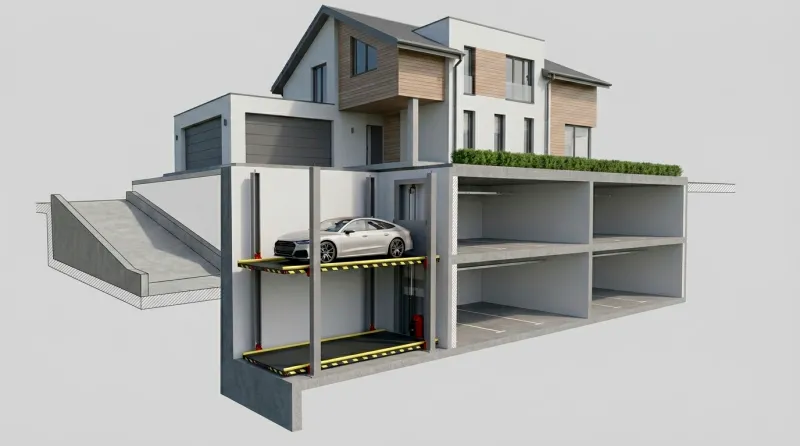
Car Elevator Lift for Parking and Private Homes: A Modern Alternative to Concrete Ramps
When designing modern residential complexes, underground parking lots, or multi-level private garages, architects and developers inevitably face the problem of space shortage. A standard concrete ramp with a safe incline angle consumes dozens of square meters of usable area — the very area that could be sold, rented out, or used for additional parking spaces.
A rational engineering solution to this problem is a car elevator (lift). The integration of hydraulic lifting systems allows for vertical vehicle transportation, saving up to 70% of space compared to classic ramps. In this article, drawing on the manufacturing experience of the PRODIS LIFT plant, we will analyze in detail the types of equipment, the nuances of site preparation, and the criteria for choosing reliable hydraulics.
Why Do Developers and Garage Owners Need a Parking Lift?
Abandoning the ramp in favor of a mechanized lift is dictated not only by the trend toward automation but also by strict economic feasibility. One square meter of commercial or residential real estate is expensive. Instead of pouring dozens of cubic meters of concrete for an inclined ramp, it is more profitable to order a car elevator, the shaft of which will occupy an area equal to the dimensions of the car itself (on average 5 x 2.5 meters).
Main tasks solved by installing a car elevator:
- Saving usable space. The platform lowers strictly vertically, freeing up space on the upper level.
- Aesthetics and stealth. In the lowered position, the cover of the scissor table can be made flush with the floor and covered with the same material (tiles, asphalt), making the mechanism completely invisible in the courtyard of a private house.
- Premium car safety. Cars with low ground clearance often scrape their bumpers or undercarriage on steep ramp inclines. The platform eliminates this risk.
- Anti-theft protection. If you raise or lower the car to another level and de-energize the control panel using an access key, unauthorized exit of the vehicle becomes impossible.
Types of Car Lifts from the Manufacturer PRODIS LIFT
Depending on the architectural features of the building, lifting height, and vehicle mass, we at the PRODIS LIFT plant design and manufacture three main modifications of automotive platforms.
1. Car Scissor Lift Tables
The most requested solution when you need to lower a car into an underground parking lot by 1-2 levels (lifting height up to 6 meters). The main technical feature is that the entire mechanism is hidden under the platform in a special pit. There are no guide columns or posts that would spoil the interior of the room.
The characteristics of PRODIS LIFT scissor tables allow lifting cars weighing up to 10 tons. A powerful hydraulic system with a consumption of 5.5–11 kW ensures a smooth lift of the car to the maximum height in 60–90 seconds. This is an ideal car lift for a garage in a country cottage or a car dealership showroom.

2. Four-Post Car Elevators
When it is necessary to transport cars to a height of up to 12 meters (for example, in multi-level logistics centers or high parking lots), the scissor mechanism becomes too metal-intensive. In such cases, we recommend four-post freight elevators.
The design consists of four load-bearing columns along which the platform moves, driven by hydraulic cylinders and heavy-duty chains. The load capacity of such systems reaches 12 tons. They require anchoring the columns to the load-bearing walls or floors of the building, but they win due to their high operating speed and the possibility of integration into a finished shaft.

3. High-Lift Car Platforms (Double Scissor)
A compromise solution for facilities where it is impossible to install load-bearing posts, but a high lifting height is required (from 4 to 8 meters). The design consists of two (or more) pairs of scissors stacked on top of each other. This geometry of the mechanism requires a slightly deeper pit during installation, but provides an impressive stroke height with a complete absence of columns above the floor level.

Engineering Approach: Safety and Installation Preparation
A car weighs from 1.5 to 3 tons, and its vertical movement requires unprecedented safety measures. Unlike cheap Chinese analogues, a professional scissor car lift of Ukrainian production PRODIS LIFT is equipped with a multi-level protection system:
- High-Pressure Hose (HPH) burst valves. Mounted directly into the hydraulic cylinders. If the oil hose is damaged or cut, the valve instantly blocks the fluid outflow, and the platform freezes in place — a fall is excluded.
- Mechanical chocks (wedges). To hold the platform on the floor during the entry and exit of the car, relieving the load from the hydraulics.
- Limit switches. Accurately position the platform at a given level with an error of up to a millimeter.
- Emergency lowering. In the event of a complete power outage at the facility, the platform with the car can be safely lowered manually using a special valve on the hydraulic power unit.
Installation Site Requirements
If you decide to buy a car elevator, it is important to lay down the correct building parameters at the foundation pouring stage. To install a scissor table, a pit (a recess in the concrete floor) with a depth of 600 to 1200 mm is required, depending on the load capacity. The concrete base must be perfectly flat and withstand point loading. In addition, it is necessary to lay a drainage system in the pit (to drain water from the wheels) and provide a three-phase power supply (380V) to connect the oil station.
How to Choose and Buy a Car Lift Without Overpaying?
Buying complex hydraulic equipment through intermediaries is always a risk of losing the warranty and overpaying. For the final price of the project to be justified, you need to order equipment directly from the manufacturer.
The PRODIS LIFT plant does not just sell finished products; we design each parking lift individually, taking into account:
- Platform dimensions for your cars (standard 5x2.5m, but changes are possible).
- Entry type (drive-through platform on two sides or dead-end).
- Location of the hydraulic power unit (inside the pit or in a separate technical room).
- Degree of protection of electrical equipment (for outdoor operation in winter or in a heated parking lot).
Optimizing indoor logistics and abandoning bulky ramps in favor of hydraulic car elevators is an investment that increases the status and value of your property. Contact our engineers for an exact load calculation and the preparation of technical specifications for your builders.