

Warehouse Loading Dock Equipment: How Dock Levelers, Dock Shelters, and Mobile Ramps Accelerate Logistics
Every warehouse or logistics complex has its "bottleneck" — the loading and unloading zone for commercial vehicles. No matter how optimized indoor storage is, if trucks stand idle in line due to manual pallet handling, the business loses money. The main engineering problem at this stage is the mismatch between the height of the concrete warehouse ramp and the floor level of the truck bed (which also changes as it is loaded or unloaded due to suspension travel).
To solve this problem, professional **loading dock equipment** is used. It creates a safe and unobstructed path between the warehouse and the vehicle, allowing forklifts, pallet jacks, and stackers to drive directly into the truck body. Based on the manufacturing experience of the PRODIS LIFT plant, we will detail the four main elements of a modern loading dock, their technical characteristics, and selection criteria.
1. Dock Levelers: The Foundation of a Modern Dock
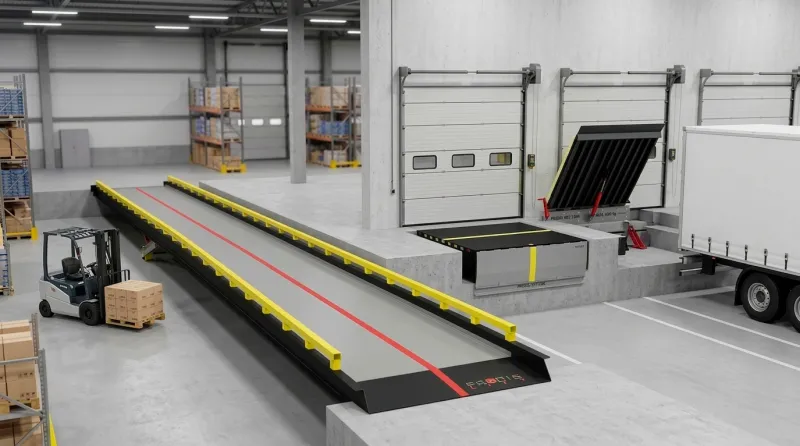
If a warehouse regularly receives heavy-duty trucks, the basic solution is a hydraulic dock leveler. This is a steel structure built into the pit of a concrete ramp, featuring a movable lip. When a truck parks backward against the dock, the platform rises, the lip flips open and rests on the truck bed floor, forming a rigid and gentle ramp.
A high-quality warehouse dock leveler can compensate for significant height differences. For example, the PRODIS LIFT product line includes models (such as the PL-600 and PL-300) that provide a working leveling range from 250 to 550 mm.
Key advantages of hydraulic dock levelers:
- High load capacity: standard platforms withstand a dynamic load of 3 to 6 tons, allowing a forklift with a heavy pallet to safely drive in.
- Speed of operation: controlled by a single button on the remote. The hydraulics automatically track the change in the vehicle's body height as it sags under the weight of the load.
- Safety: the steel sheet has a tear-drop (checkered) anti-slip coating for wheels, and the built-in safety system instantly blocks the platform in case the truck suddenly departs.

2. Folding Loading Bridges: A Budget-Friendly Alternative
In cases where cargo traffic intensity is medium and the height difference between the ramp and the vehicle is small, there is no need to pour deep pits for complex hydraulics. A rational solution is the installation of a folding loading bridge.
The bridge is mounted on the edge of the concrete ramp. When not in use, it is locked vertically, and when docking with a vehicle, it is lowered manually (using a side handle) onto the truck bed. The mechanical bridges of our production can compensate for a height difference from -150 to +300 mm with a platform length of 1 to 2 meters. Despite the apparent simplicity of the design, they are made of durable thick-sheet steel with an anti-corrosion coating and confidently hold a load of 2 to 6 tons.

3. Dock Shelters: Climate Control and Energy Saving
Connecting the dock leveler to the vehicle solves the problem of equipment passage but leaves the door perimeter open. In summer, this leads to the leakage of cooled air; in winter, it causes the warehouse to cool down, drafts, and product spoilage (especially in the pharmaceutical and food industries). To close this gap, a dock shelter is installed.
The truck, reversing, literally "drives into" the dock shelter, and its elastic front flaps (or inflatable cushions) tightly embrace the vehicle body along the perimeter.
Main types of dock shelters:
- Tent (frame) shelters: the most common and unpretentious design made of a rigid frame and high-strength PVC materials. It withstands the mechanical friction of the vehicle body perfectly.
- Inflatable shelters: provide 100% sealing by squeezing the vehicle body with air cushions. Indispensable for freezer warehouses with strict thermal insulation requirements.

4. Mobile Yard Ramps: Loading Trucks from Ground Level
Often, businesses rent hangars or warehouses where a concrete ramp is physically absent, and the entire process takes place right on the asphalt. In such a situation, transferring pallets from a truck with a forklift is extremely difficult. The engineering solution is a mobile yard ramp (a movable loading trestle).
This is an all-metal inclined platform 9 to 12 meters long, equipped with transport wheels and its own hydraulics. A forklift hooks it by the tow hitch, brings it to the truck, and using jacks or a hydraulic power unit, the ramp height is adjusted (in the range of 900–1700 mm), creating a gentle slope from ground level straight into the truck.
PRODIS LIFT mobile ramps have a massive weight (from 2000 kg) and a strong welded frame, which ensures their rigidity and ability to withstand the passage of heavy machinery weighing up to 10,000 kg.

A Comprehensive Approach: How to Choose and Order Equipment?
The organization of a loading dock does not tolerate cookie-cutter solutions. If you plan to modernize your warehouse, it is extremely important to consider the dimensions of the serviced transport, traffic intensity, and the temperature regime of the premises. Often, the combination of "dock leveler + dock shelter + sectional doors" covers 90% of an enterprise's logistics tasks.
So that the final project price does not exceed the budget due to intermediary services, you should buy equipment directly from the manufacturer. At the PRODIS LIFT plant, you can not only buy a separate unit but also order a comprehensive project for a loading dock. Our engineers will select the optimal platform length, calculate the load-bearing capacity, and provide technical specifications for preparing concrete pits for your contractors.