

Construction Mast Cargo Lift: Characteristics, Installation, and Selection Rules
The construction of multi-story residential complexes, the reconstruction of industrial facilities, and large-scale facade work require a continuous and fast supply of materials to heights. Traditionally, this task is solved using tower or truck cranes. However, the rental, delivery, and maintenance of heavy crane equipment cost contractors huge sums of money. Furthermore, when the "shell" of the building is already erected and interior finishing works begin, using a crane to supply pallets of dry mixes or drywall becomes impractical.
A rational, economical, and safe alternative is the construction mast hoist. This equipment allows you to organize uninterrupted vertical logistics right on the building's facade or inside a shaft, significantly reducing the developer's estimated costs. In this article, drawing on the engineering experience of the PRODIS LIFT plant, we will analyze in detail the design, characteristics, and installation nuances of this equipment.
Design and Operating Principle: How Does an Electromechanical Lift Work?
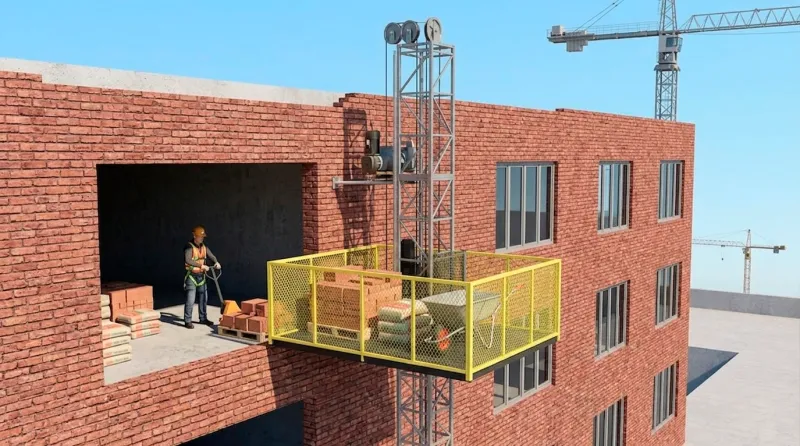
The basis of the design is a vertical load-bearing mast (truss), assembled from individual metal sections. A cargo cage (platform) with guardrails moves along the guide rails of this mast.
The equipment manufactured by PRODIS LIFT has a reliable electromechanical drive. Usually, a powerful electric winch (traction mechanism) is installed at the base of the mast. A steel cargo wire rope transmits the tractive effort to the cargo platform through a system of pulley blocks, forcing it to rise or fall. This architecture simplifies maintenance since the main power unit is located at the bottom, in an area easily accessible to mechanics.
[Place for photo 1: Loading: Electromechanical construction cargo lift at ground level (photo 3-1.jpg)]
Key Characteristics of Cargo Mast Lifts
When designing high-altitude equipment, you cannot rely on average figures. Each construction cargo lift is calculated for the specifics of a particular facility. In the standard PRODIS LIFT line, we focus on the following operational parameters that cover 95% of developers' needs:
- Load capacity: from 500 kg to 3000 kg. This allows you to lift both light insulation materials and heavy pallets of bricks or bulky equipment.
- Lifting height: the modular mast system allows the structure's height to be increased up to 150 meters as the building grows.
- Cargo cage dimensions: designed taking into account the standard dimensions of construction pallets (Euro pallets) so that unloading can be carried out using a conventional pallet jack.
- Energy efficiency: the use of modern electric motors with optimized energy consumption reduces the load on the temporary electrical networks of the construction site.
[Place for photo 2: Lifting: Movement of the cargo cage along the mast (photo 3-2.jpg)]
Installation and Fastening: Reliable Anchoring to the Building
One of the main advantages of the equipment is its modularity. The cargo mast lift grows along with the building. The mast sections have a small mass and height, which allows them to be mounted without the involvement of heavy special equipment (often, installation is carried out from the lift platform itself).
However, a free-standing mast several tens of meters high will inevitably be subjected to wind loads and dynamic vibrations. To ensure rigidity, the facade lift must be attached to the load-bearing walls or floors of the building.
As shown in our diagrams, fastening is carried out using special wall supports (tie rods), which are installed at a certain pitch along the entire height of the mast. These tie rods transfer horizontal loads to the facade, providing absolute vertical stability and a smooth ride of the platform without swaying.
[Place for photo 3: Facade Fastening: Wall supports and tie rods of the mast lift (photo 3-4.jpg)]
Safety Systems: Protection of People and Cargo
Rope breakage or overloading are the main fears on any construction site. Our equipment meets strict industrial safety standards. The following elements are integrated into the design:
- Safety brakes (catchers): mechanical devices that instantly block the cage on the mast guides in the event of a traction rope break or exceeding the permissible descent speed.
- Limit switches: automation that stops the platform in the extreme upper and extreme lower positions, preventing it from hitting the base or flying off the mast.
- Overload protection: sensors that block the winch from turning on if the mass of the load in the cage exceeds the nominal specified load capacity.
Construction Economics: Why Is It Profitable to Buy a Lift from the Manufacturer?
Many contractors prefer to rent equipment, but when implementing long-term projects (from 6 months) or regular development, it is more profitable to buy your own equipment. Your own lift pays for itself in 1-2 objects, after which it begins to bring pure savings.
To ensure the final price is justified, you should order the equipment directly from the manufacturing plant. By cooperating with PRODIS LIFT, you get more than just "hardware." Our engineers will calculate the number of sections and wall mounts for your facade, adapt the dimensions of the cabin, and provide full technical support and warranty service. Invest in reliable construction logistics that will not let you down at the height of the building season.