

Freight Elevator vs. Rack-Mounted Cargo Lift: Which is More Profitable and Easier to Install?
Expanding production or modernizing a multi-story warehouse complex inevitably confronts business owners with the problem of vertical logistics. Moving heavy pallets, raw materials, or finished products between building levels requires reliable equipment. Historically, the first solution that comes to mind is installing a classic freight elevator. However, modern engineers and logisticians are increasingly opting for an alternative solution — rack-mounted cargo lifts. Why is this happening, and what is more profitable for your enterprise? Let's figure it out.
Bureaucracy and Installation Time: The Main Problem of Classic Elevators
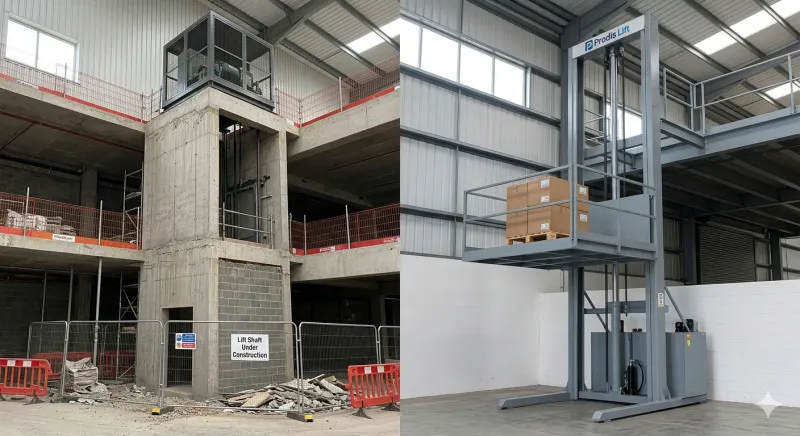
Installing a traditional freight elevator is always a major construction project. It requires building a solid load-bearing shaft, organizing a deep pit, and, most critically, allocating a separate machine room for winches and control stations. All this "eats up" dozens of square meters of usable commercial space.
But the main headache for business lies not in concrete, but in paperwork. Freight elevators are classified as high-risk objects. Their design, installation, and commissioning are accompanied by strict bureaucracy, obtaining permits from inspection authorities, and regular expensive checks. From the moment the elevator is ordered to its actual launch, many months can pass.
An Engineering Alternative: How Rack-Mounted Systems Work
A rack-mounted (mast) lift solves these problems at their root. It is a self-supporting metal structure in which the cargo platform moves along powerful vertical guides (racks/masts) using an electro-hydraulic drive. Unlike an elevator, the hydraulic cylinders and pumping station take up minimal space and can be located next to the structure.
Such equipment does not need a capital brick shaft — a metal frame with fencing is sufficient. The pit depth is minimal, and in some cases, the lift is installed directly on a flat floor using a small access ramp. The registration process for such equipment is much simpler, and installation takes several times less time.
Technical Capabilities: From Light Warehouses to Heavy Industry
There is a stereotype that mast lifts are inferior to elevators in power, but the technical specifications of the equipment refute this myth. The choice of configuration depends solely on the weight of your cargo:
For moving goods weighing up to 5 tons (5000 kg), cantilever cargo lifts and two-post hydraulic lifts are ideal. They provide a smooth lift to a height of up to 12 meters at a speed of 0.1–0.4 m/s. This is an optimal choice for supermarkets, logistics centers, and small manufacturing facilities. The platform is made of steel with an anti-corrosion coating, and control is carried out from a simple push-button post.
For extreme industrial loads, four-post cargo lifts, as well as mine freight hoists, are designed. Thanks to the distribution of the load across four guides, such systems are capable of lifting a colossal weight of up to 20 tons to a height of up to 12 meters. At the same time, the platform dimensions can be custom-made to accommodate oversized machinery, long materials, or vehicles.

Logistics Economics: Why a Rack-Mounted Mechanism is More Profitable
Comparing the budgets of the two solutions, the scales confidently tip towards mast hydraulics. The final estimate for design, equipment purchase, and construction/installation work for a rack-mounted lift is on average 30-50% lower than for a similar freight elevator. Maintaining a hydraulic system also costs the enterprise less: it has fewer friction parts, no complex winches, and no expensive cable systems that require frequent replacement.
5 Reasons to Order a Cargo Lift from a Ukrainian Manufacturer
When purchasing complex hydraulic equipment, it is important to have direct contact with the developer. By ordering a system from the PRODIS LIFT LLC plant, you get the following advantages:
- Custom design of platform dimensions for your packaging and pallets (without imposing inefficient standard sizes).
- Use of high-strength thick-walled steel, providing a multiple safety margin even during round-the-clock operation.
- Integration of energy-efficient electro-hydraulic systems, reducing the enterprise's electricity costs.
- Absolute safety: implementation of hose burst valves, mechanical catchers, and limit switches.
- Comprehensive supply and installation of rack-mounted freight elevators by the plant's own teams with an official warranty.

If you face the task of connecting several levels of a warehouse or workshop, do not rush to start expensive construction of an elevator shaft. Contact the engineers at PRODIS LIFT — we will select a rack-mounted cargo lift configuration that will save your money, time, and commercial space.